Plusmark

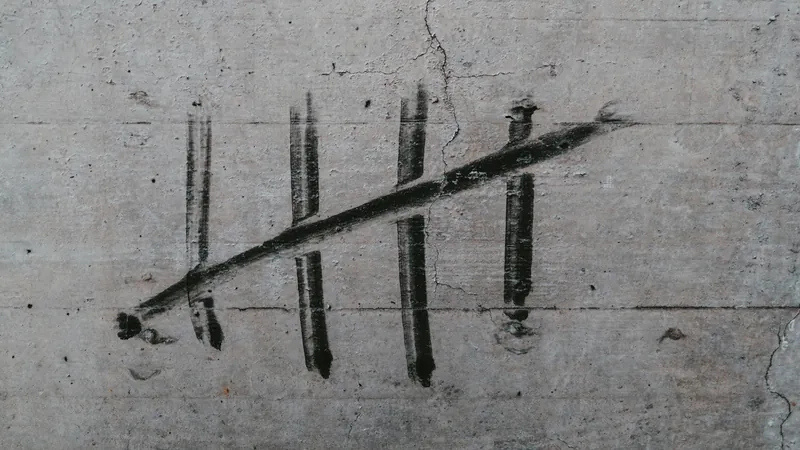
Tally marks are the quickest way to count by hand: one stroke for each thing, and every fifth stroke drawn across the four before it to close a group. To read them, count the finished groups in fives and add the loose strokes at the end, so three closed groups and two single strokes make 17. This guide covers how to write and read them neatly, the other tally systems people use around the world, a little history, and when a tally sheet beats a counter (and when it doesn't).
The short version
- Draw four upright strokes, then a fifth stroke across them. That closed group is 5.
- To read a tally, count the groups by fives (5, 10, 15...) and add any loose strokes after the last group.
- In China, Japan and Korea people often write the character 正, one stroke per count, so each finished character is 5.
- Foresters, and many people in France, Spain and South America, use a dot-and-line square that counts to 10.
How to write tally marks
Start with a single upright stroke for the first thing you count. Add a stroke beside it for each one after: two, three, four. On the fifth, draw a line across the four uprights, usually on a slant. That's a finished group, called a five-bar gate in Britain and a picket fence in many other places. Then start the next group a little way to the right.
A few habits keep a tally readable, even hours later:
- Leave a clear gap between groups, so two fives never run together into one blur.
- Keep the strokes the same height and about the same distance apart. A short, faint stroke is easy to miss when you total up.
- Start a new line after a set number of groups, such as four groups (20) or ten groups (50). Then every full line is a number you already know.
- Give each thing its own row. If you're counting cars and vans, tally them on separate lines rather than mixing them and sorting it out later.
How to read and count them
Don't count tally marks one stroke at a time if you can help it. Count the closed groups instead, by fives: 5, 10, 15, 20. Then add the loose strokes after the last group. Four groups and three strokes is 23.
For long tallies, count by lines. If every line holds ten groups, each full line is 50, so three full lines plus a short line of two groups and one stroke is 150 + 10 + 1, or 161. Circling each pair of groups as you go turns every circle into a 10, which makes a crowded sheet much faster to total.
If you're adding up several sheets, write each sheet's total in the corner before you combine them. A mistake is far easier to find on one sheet than in a whole pile.
Other ways to tally
The 正 character
In China, Japan, Korea and other places that use Chinese characters, people often tally with 正, a character meaning right or correct that takes exactly five strokes to write. Each stroke is one count, written in the normal stroke order, and a finished 正 is five. You'll see it on classroom whiteboards for votes and on scoreboards for games. Read it the same way as the five-bar gate: count the full characters by fives, then add the strokes of the unfinished one.
The dot-and-line square
This one counts to ten in a single box. The first four counts are dots at the corners of a square. Counts five to eight join the dots with lines, one side at a time. Counts nine and ten are the two diagonals, which leave a box with an X through it. It's common in France, Spain and South America, and foresters use the same kind of dot tally on survey forms, where each dot and line stands for one tree. Because every finished box is ten, totals are quick: seven full boxes plus four dots and three sides is 77.

A little history
People have made marks to keep count for a very long time. The Ishango bone, found in what is now the Democratic Republic of the Congo, is around 20,000 years old and has groups of marks cut along its sides. It's often described as early evidence of counting, though what the marks meant is still debated.
The most famous tallies are English. For centuries the Exchequer recorded money owed and paid on wooden tally sticks: a stick was notched to show the amount, then split lengthwise so that each party had a matching record. The Bank of England has one recording one of its first loans to the government, in 1694. The lender's half was called the stock and the debtor's half the foil, and the Science Museum notes that the lender's half is where "stock" as a word for a financial certificate comes from. If the two halves didn't fit back together, something was wrong.
The Exchequer was abolished in 1826 and left behind a large pile of old sticks. In October 1834 workmen were told to burn them in the furnaces under the House of Lords. The fire got out, and it destroyed most of the old Palace of Westminster.
Tally marks or a counter?
When tally marks win
- Lots of categories at once. A sheet with a row each for cars, vans, bikes and buses is hard to beat for a traffic count.
- Everyone can see it. A whiteboard tally for a vote or a game score is out in the open, and nobody has to trust a screen.
- Nothing to set up. A pencil and the back of an envelope work anywhere, with no battery to run out.
- The record is the count. The sheet itself is what you keep, file or hand in.
When a counter is better
- Speed. At a busy door, a stroke per person falls behind fast. A tap keeps up, which matters when you're counting people at an event.
- Counting without looking. You can't write while you swim, pray with beads or do push-ups. See counting dhikr or counting reps.
- Big numbers. Past a few hundred, a page of gates is slow to total and easy to miscount.
- When it happened. A tally shows how many, never when.
- Counting over days. A running total that starts fresh each morning is fiddly on paper. More on that in counting habits.
Common mistakes
- Drawing the fifth stroke upright. Five uprights in a row read as four plus one, or as six, depending on who's looking.
- Closing the gate on the fourth stroke. A group of four throws off every total after it.
- Groups that touch. Leave space, or two fives look like one.
- Counting strokes one by one at the end. Count by fives (or tens, if you circled pairs).
- Mixing categories on one line. Separate rows from the start.
Keep count with Plusmark
If you like the look of tally marks but want something faster than a pencil, Plusmark uses them too. Give a counter a goal and the counter screen shows it as a row of five-bar gates that fill in as you tap. A goal of 8 is eight marks waiting to be filled, and a big goal uses 20 marks, each one a twentieth of the way. The screen tells you how many are left, and there's a little celebration when you get there. The same marks show on the Live Activity on your Lock Screen and on Apple Watch.
To set one up, pick one of the starters or name your own counter, then:
- Each tap adds: 1 for most tallies, or 2, 5, 10 or a custom number.
- Goal: optional. At least for a target, or At most for a limit that warns you but never blocks a tap.
- Resets: every day, week or month, or never. History keeps every tap either way, timed to the second, which a sheet of paper can't do.
If you turn on Differentiate Without Colour in your iPhone's accessibility settings, the empty marks become outlines, so you can read your progress by shape alone. The ideas page has set-ups for counting people at the door, birds, laps and more, and the FAQ answers the common questions.
Count it with Plusmark
Plusmark is the tally counter for iPhone, iPad, iPhone Duo and Apple Watch. Name a counter, tap the big + pad, and every tap is saved with its time, with goals, widgets and Siri.