Plusmark

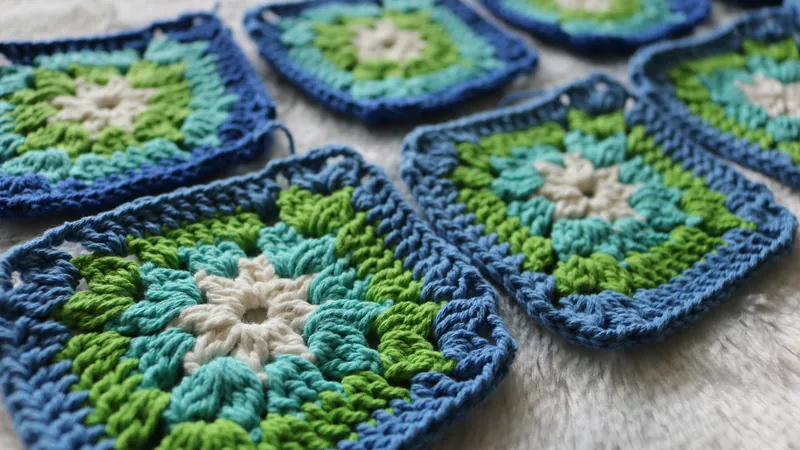
To count crochet stitches, look along the top edge of the row: each stitch has a sideways V on top, two loops lying side by side, and each V is one stitch. Don't count the loop on your hook. Before you write the number down, check one thing: whether your pattern counts the turning chain as a stitch. For single crochet it usually doesn't; for taller stitches it usually does. Count at the end of every row or round, and a miscount costs you one row to fix, not ten.
The short version
- Count the Vs along the top of the row, or the posts of tall stitches. The loop on the hook isn't a stitch.
- Turning chains: 1 chain for single crochet (not counted), 2 for half double, 3 for double, 4 for treble (usually counted as the first stitch). Your pattern's notes come first.
- Rounds: put a stitch marker in the first stitch of every round and move it up as you go.
- Count every row or round against the number the pattern gives.
How to count stitches
Hold the work so you're looking down at the top of the last row. Each stitch shows a V of two loops along the top edge, a bit like a chain lying on its side. Count those Vs from one end to the other. For tall stitches such as double crochet, you can also count the posts, the upright bodies of the stitches, which are easier to see in dark or fluffy yarn.
- Leave out the loop on the hook and the slip knot. Neither is a stitch.
- Check against the pattern. Most patterns give the expected count at the end of a row, written like "14 sc" or "(14 sc)". That's the number you should have, not an instruction to work more.
- Mind the first row. In "dc in 4th ch from hook", the three chains you skip count as the first double crochet. So "15 dc" at the end of that row includes them.
The turning chain: stitch or not?
The turning chain lifts your yarn to the height of the next row. How many chains you make depends on the stitch:
- Single crochet (sc): 1 chain. It doesn't count as a stitch, so work your first sc into the first stitch, and skip the turning chain at the end of the next row.
- Half double crochet (hdc): 2 chains.
- Double crochet (dc): 3 chains.
- Treble crochet (tr): 4 chains.
For hdc, dc and tr, the turning chain usually stands in for the first stitch of the row. You skip the stitch at its base, and at the end of the next row you work your last stitch into the top of the turning chain. Many modern patterns change this, for example "ch 2 does not count as a stitch". When the pattern notes say how, follow the pattern over the general rule.
Most edges that grow or shrink come down to this. Gaining a stitch every row usually means working into the base of a turning chain that counts. Losing one usually means skipping the turning chain at the end of the row.
Stitch markers on rows
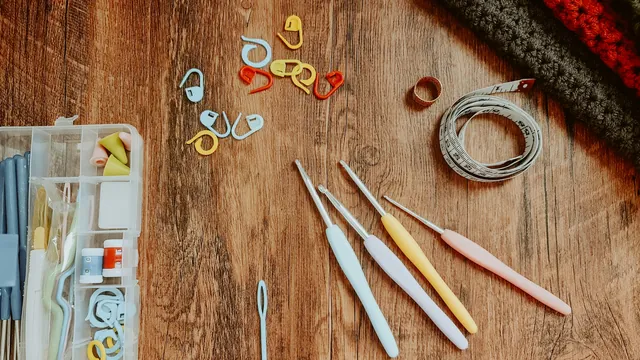
- Mark the first and last stitch of a row, especially the top of a turning chain. It's the stitch people miss most.
- Mark every 10 or 20 stitches on long rows, so a recount means counting between two markers, not the whole row.
- Mark every 10th row at the edge. Then counting rows is a matter of counting markers and adding the few since.
Locking markers stay put while you handle the work; split rings or a scrap of contrast yarn are quicker to move.
Counting rows
Count rows along one edge, or straight up a column of stitches near the middle. Tall stitches are easy: each row of double crochet is a clear band of posts. Rows of single crochet are short and dense, so take it slowly, or run a blunt needle up the column one row at a time. With a marker every 10 rows, you only ever count from the last one.
Counting rounds
Joined rounds
In joined rounds you finish each round with a slip stitch into the first stitch, then chain up for the next. The join leaves a visible seam, which makes the start of each round easy to find. Joined rounds are usually preferred for flat circles and for double crochet.
Spiral rounds
For amigurumi and other seamless shapes, you work in a spiral with no join, so there's nothing to show where one round ends. A stitch marker in the first stitch of the round isn't optional here. Move it up into the first stitch of each new round as you reach it.
The +6 check
A flat circle in single crochet usually starts with 6 stitches and adds 6 every round: 6, 12, 18, 24 and so on. That gives you a quick check, since the stitch count should be six times the round number. Too few increases and the circle cups; too many and it ruffles. Count the total at the end of each round before you move on.
Common mistakes
- Counting the loop on the hook as a stitch.
- Mixing up turning chain rules between sc and taller stitches.
- Missing the last stitch, the one in the top of the turning chain.
- Forgetting to move the marker in spiral rounds, so every round after is off by a few stitches.
- Only counting at the end of the piece, when a mistake ten rows down means a lot of ripping.
Count it with Plusmark
Your hook and yarn take both hands, so a counter you can tap with a knuckle, or talk to, is handy. Plusmark works well for rows and rounds.
- Starter: Rows. It never resets, and each tap adds 1. Working in the round? Make your own counter called Rounds the same way.
- Goal: the number of rows or rounds in the pattern. Tally marks show how close you are, and there's a little celebration at the end.
- Hands busy? Ask Siri, "Add one to Rows in Plusmark". On an iPad with a keyboard, Space or Return adds one.
- Mistakes: Undo or Subtract 1 for an extra tap, and Set Count in Edit Counter to type the right number after a recount.
Want stitches too? Make two counters, Stitches and Rows, and count both from the list, where every counter's row has its own + key. To be clear, there's no linked stitch-and-row counter, so the stitch count won't start over by itself at the end of a row. For most patterns it's simpler to count rows or rounds in Plusmark and check your stitch count against the pattern by eye.
Lock Pad stops stray touches with the phone in your lap. The row counter guide has the full set-up, and if you knit too, see how to count rows in knitting and counting with Siri.
Count it with Plusmark
Plusmark is the tally counter for iPhone, iPad, iPhone Duo and Apple Watch. Name a counter, tap the big + pad, and every tap is saved with its time, with goals, widgets and Siri.