Plusmark

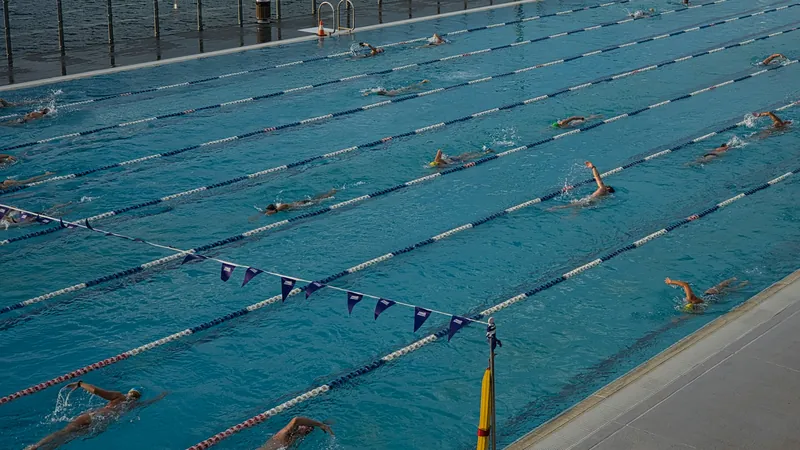
The easiest way to count laps when you swim is to count lengths, one each time you touch the wall, and to group them into small chunks so your head only has to hold a little number. First, know your pool. In a 25-yard pool, 66 lengths is the "swimmer's mile" and about 70 lengths is a real mile. In a 25-metre pool, 40 lengths is a kilometre. In a 50-metre pool, it's 20. This guide covers laps versus lengths, the distances for each common pool, counting tricks that actually work in the water, and how to count for someone else from the side.
The short version
- A length is one end of the pool to the other. A lap means a length to some swimmers and there and back to others, so say which one you mean.
- The common pools are 25 yards, 25 metres and 50 metres. The same number of lengths is a different distance in each.
- The swimmer's mile is 1,650 yards (66 lengths of a 25-yard pool) or 1,500 metres (60 lengths of a 25-metre pool). Both are a bit short of a real mile.
- Count in fours (one 100) or count at one end only, and you'll lose track far less often.
Lap or length?
A length is simple: you push off one wall and touch the other. "Lap" is where the arguments start. US Masters Swimming points out that some swimmers use lap to mean one length while others mean down and back, which is why coaches usually write workouts in lengths or total distance instead.
Neither is wrong, but mixing them up halves or doubles your distance without you noticing. Pick one and stick to it. Counting lengths is the safer choice: every touch is one, and the number matches the way pool distances and workouts are written.
How many lengths make a mile or a kilometre
A mile is 1,760 yards, or 1,609 metres. Here's how that works out in the three common pools, counting lengths:
25-yard pool (common in the US)
- 1 mile: 70.4 lengths, usually rounded to 70 or 72
- Swimmer's mile (1,650 yards): 66 lengths
- 1 kilometre: about 44 lengths (each length is 22.86 metres)
25-metre pool (short course)
- 1 kilometre: 40 lengths
- 1,500 metres: 60 lengths
- 1 mile: about 64.4 lengths
50-metre pool (long course, Olympic size)
- 1 kilometre: 20 lengths
- 1,500 metres: 30 lengths
- 1 mile: about 32.2 lengths
Not sure how long your pool is? Ask at the desk. Hotel and leisure pools can be an odd size, like 20 or 33 metres, and a pool that "looks about 25" can easily be 25 yards, which is a little under 23 metres.
The swimmer's mile
Distance swimmers call the 1,650-yard freestyle "the mile". It's 66 lengths of a 25-yard pool, and as US Masters Swimming notes, it actually falls 110 yards short of a true mile. In metre pools the matching event is the 1,500 metres, sometimes called the metric mile, which is about 1,640 yards.
So if a friend says they swam a mile, it's worth asking which one. For your own log, write down the distance and the pool, like "1,650 yd, 25 yd pool", and the number will still make sense next year.
Counting tricks that work in the water
Your brain is busy breathing, turning and not hitting the swimmer in front, so a long number slips easily. These help:
- Count at one end only. Say the number each time you touch the same end, the shallow end for example, and you only have to count half as often. Each number is two lengths.
- Count in fours. In a 25 pool, four lengths is 100. Count "100, 200, 300" instead of "1 to 66", and a mile becomes 16 and a half hundreds.
- Repeat the number all the way down. Thinking "seven, seven, seven" with every stroke makes it much harder to forget whether you're on seven or eight.
- Change something every 100. Switch stroke, or switch your breathing pattern, at each 100. Your body remembers "this is the backstroke one" better than a bare number.
- Use the pace clock. If you know a 100 takes you about two minutes, the clock is a check on your count.
- Break it into sets. Swimming 10 x 100 instead of 1,000 straight means you only ever count to four, plus the number of the set.
- Leave a marker. A row of coins or pool toys on the deck, moved one at a time, is a lap counter that never runs out of battery.
Counting for someone else
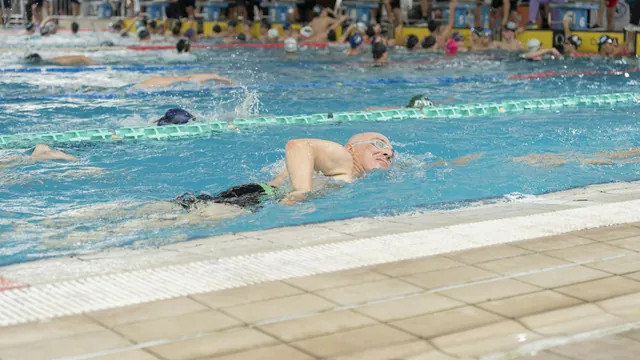
If you're a coach, a parent or a training partner on the deck, stand at the turning end, where you can see each touch. Count the touch, not the push off, and make one tally for every touch. With several swimmers, keep a separate count for each, labelled by lane or name, and never try to hold two numbers in your head at once.
A tally on a clipboard works. So does a clicker or a phone, as long as it can't fall asleep mid-swim. It also helps to note the time now and then: lengths that suddenly get slower are often the moment the count went wrong.
What about Apple Watch?
For your own swim, Apple Watch has its own answer. In the Workout app, a Pool Swim asks for the pool length before you start, then tracks your sets and rests and shows your total distance when you finish. Apple also locks the screen with Water Lock during a swim, so stray splashes don't tap anything. That's useful for you, and it also means apps you count with by tapping, Plusmark included, aren't the tool for counting in the water.
Whatever counts for you, set the pool length right. A 25-yard pool entered as 25 metres adds about 9% to every swim.
Common mistakes
- Mixing laps and lengths. Decide which you're counting before the first push off.
- Assuming 25 metres. Yards and odd-sized pools are common. Check.
- Counting the start. The first push off isn't a length until you touch the other end.
- Calling 1,650 yards a mile in your log. It's fine as a swimmer's mile, but write the real distance too.
- Counting both ends and losing the odd one. If you keep slipping by one, count at one end only.
Count it with Plusmark
Plusmark counts taps on a screen, so it isn't made for counting in the water. Where it does help is the poolside: a coach, parent or partner counting lengths for a swimmer, or counting several swimmers at once.
- Start with the Laps starter. It counts the week and starts again on the first day of your week. For a count per session, set Resets to Daily.
- One tap per length as the swimmer touches. Each tap adds 1 by default, and you can set a goal, like 66 for a swimmer's mile.
- Feel every 100. Turn on a milestone haptic every 4, and you'll get a firm tap at each 100 in a 25 pool without looking down.
- Count from your wrist. On Apple Watch, tap the pad or use Double Tap as the swimmer touches the wall, and swipe between counters for different lanes.
- Keep the iPhone awake. Keep Screen On, from the counter's More menu, stops it sleeping between lengths.
- A rough length log. Plusmark isn't a stopwatch, but History saves every tap to the second, so you can see when each length was counted.
The lap counter guide walks through the setup, and if you run as well as swim, counting laps on a running track covers the track side. Plusmark runs on iPhone, iPad and Apple Watch, and the FAQ answers the rest.
Count it with Plusmark
Plusmark is the tally counter for iPhone, iPad, iPhone Duo and Apple Watch. Name a counter, tap the big + pad, and every tap is saved with its time, with goals, widgets and Siri.