Plusmark

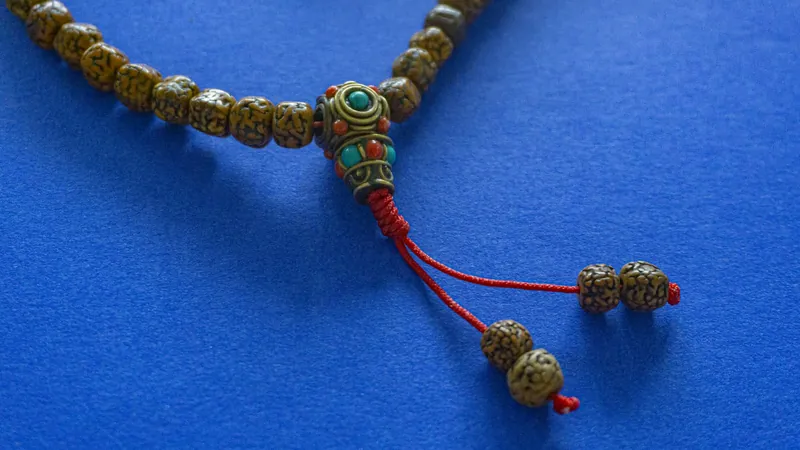
A mala usually has 108 beads because 108 is a sacred number in Hindu and Buddhist traditions, and one trip round the beads is one round of japa: 108 recitations of a mantra or a divine name. There's no single agreed reason why the number is 108, and different traditions explain it in their own ways, a few of which are below. This guide also covers the larger guru bead, how people hold and move the beads, and how to keep track when you chant many rounds a day.
The short version
- Japa is the repeated recitation of a mantra or a name of God, aloud, in a whisper or silently.
- A mala has 108 counting beads and usually one larger guru bead that marks the start and end of a round.
- One round is 108 recitations. Many people chant a set number of rounds each day.
- In many traditions you don't cross the guru bead: you turn the mala and go back the other way.
What japa is
Japa is an old and widespread practice in Hinduism, and repetition with prayer beads is common in Buddhism too. You choose a mantra, or a name of God, and repeat it again and again with attention. Some people chant aloud, some move their lips in a whisper, and some repeat the words silently in the mind.
Britannica notes that mantras are often recited 108 times, usually with the help of prayer beads. In devotional traditions the repetition of God's name is a practice in itself: in ISKCON, the Hare Krishna movement, initiated members vow to chant at least sixteen rounds of the Hare Krishna maha-mantra every day.
Why 108?
The honest answer is that 108 has been treated as a special number for a very long time, and the reasons people give depend on the tradition. Some of them:
- A sacred number in Hinduism. 108 is widely seen as auspicious, which is why mantras are so often recited 108 times.
- 100, plus 8 to be sure. The Tibetan Nuns Project explains that in Tibetan Buddhism one mala counts as 100 recitations, with 8 more said to make sure of proper concentration.
- The words of the Buddha. The same source links the 108 beads to the Kangyur, the collected words of the Buddha, in 108 volumes.
- Patterns in the number. You'll also read numerical explanations, such as 108 being 12 times 9. These are explanations people offer, rather than a fixed origin.
None of these is the one official answer, and teachers and lineages differ. If you were given a mala by a teacher, their explanation is the one that matters for your practice.
Shorter malas are common too, such as wrist malas. On a mala of 54 beads, two times round makes 108; on one of 27, four times round.
The guru bead
Most malas have one bead that's larger or different from the rest, often with a tassel below it. It isn't counted. It's usually called the guru bead, and in some Hindu traditions the meru. The Tibetan Nuns Project describes it as representing the relationship between the student and the teacher.
- Start beside it. Begin your first recitation on the bead next to the guru bead.
- Turn at the end. When you come round to the guru bead again, the round is done. Many people don't cross over it, as a sign of respect, but turn the mala and go back the other way for the next round.
- Marker beads. Some malas, especially Tibetan ones, have small marker beads that divide the strand into sections, so you can feel a quarter or a third of the way round.
How to hold and move the beads
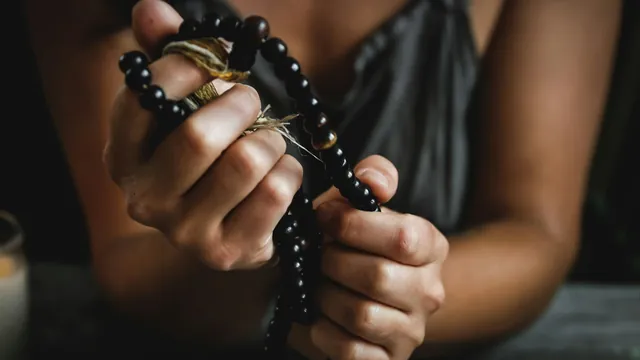
Practice varies, so if you have a teacher, follow the way they show you. Two common ways:
- In Tibetan practice, the Tibetan Nuns Project describes holding the mala gently, generally in the left hand, with the first bead between the index finger and thumb. With each recitation, the thumb brings the next bead over the index finger.
- In many Hindu traditions, the mala rests in the right hand and the beads are moved with the thumb, often keeping the index finger off the beads.
Either way, keep the movement small and steady. One bead, one recitation. The rhythm of the beads is part of what helps the mind settle.
Counting rounds
The mala counts the recitations, but if you chant several rounds a day you still need to keep track of the rounds. Sixteen rounds is 1,728 recitations, and it's easy to lose track of whether you've done eleven or twelve. Some ways people manage it:
- Counter beads: some malas have a short string of small sliding beads; move one after each round.
- Fingers or coins: fold a finger, or move a coin from one pocket to another, after each round.
- A tally: one stroke on a card for each round. (More on writing tally marks.)
- A counter: one tap after each round, on a phone or watch.
Tips for counting japa
- Decide the number before you begin. Knowing it's four rounds this morning stops the counting from becoming the focus.
- Mark each round straight away, before you turn the mala, not "in a minute".
- Spread rounds through the day if a large number is hard to do at once, and note each one as you finish it.
- Let quality lead. Clear, attentive repetition matters more than speed, as many teachers stress.
Count it with Plusmark
When you don't have your mala with you, or you'd like a record of your rounds, Plusmark can help in two ways.
Count every recitation. Start from the Beads starter and change its milestone haptic from 33 to 108. Each tap adds 1, and you'll feel a firm tap at the end of each round without looking.
Count rounds. Make a counter called Rounds and set:
- Each tap adds: 1, one tap per round.
- Goal: At least 16, or your own number. Tally marks fill as you go, and there's a little celebration when you reach it.
- Resets: Daily, at midnight. Every day before stays in History, and Activity shows your last 7 days and your streak.
On Apple Watch, tap the pad or use Double Tap, a pinch of your fingers that works with your eyes closed, and swipe or turn the Digital Crown to move between counters. The click sound is off unless you turn it on, and there are no ads and no account. The prayer bead counter guide has the full set-up. For other prayer bead traditions, see the rosary and dhikr after salah.
Count it with Plusmark
Plusmark is the tally counter for iPhone, iPad, iPhone Duo and Apple Watch. Name a counter, tap the big + pad, and every tap is saved with its time, with goals, widgets and Siri.